Cake Pricing Calculator
Underpricing is one of the most common mistakes home bakers make — ingredients are only part of the cost. This calculator adds your ingredients, the hours you spend baking and decorating, overheads like electricity and equipment, and packaging, then applies your profit margin to give a cake price and a price per serving you can compare with local market rates.
- Free to use
- No sign-up
- Runs in your browser
Cake pricing calculator
Ingredients
Cake Pricing Pack
Excel cake pricing workbook with ingredient cost per gram and price formulas, a cake order form, a price list template and a printable serving chart.
- Ingredient cost sheet (XLSX)
- Recipe pricing (XLSX)
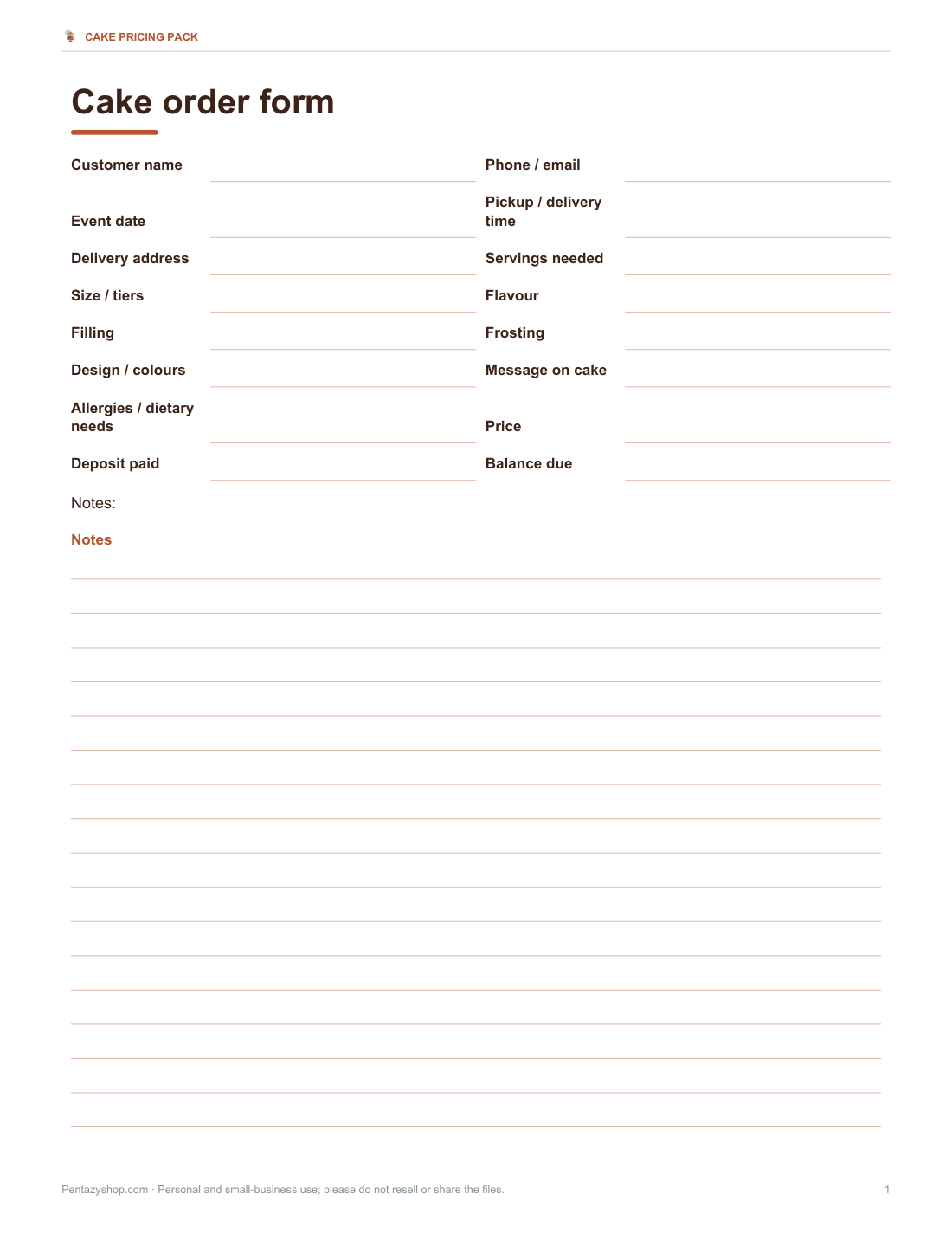
- Order form (PDF/DOCX)
- Price list (PDF/DOCX/XLSX)
- Serving chart (PDF)
Formats: XLSX, PDF, DOCX. Instant download after payment (link valid 72 hours, up to 5 downloads). AI-assisted: the templates were drafted with AI help and reviewed and laid out before publishing.
$7.00 USD, one-time 5 files · about $1.40 each
- Instant download
- 7-day refund
- Secure checkout by Stripe
7-day money-back guarantee. Full refund within 7 days of purchase, even after you download.
Free sample: Ingredient Costs (PDF, 98 KB)
Full refund within 7 days — see the refund policy and license.
Free printables
Single sheets you can print right now, no sign-up. The full pack adds every sheet in one download plus the editable files.
 Ingredient Cost Sheet
 Printable Cake Recipe Pricing Sheet
 Printable Cake Order Form
 Printable Cake Price List
 Printable Cake Serving Chart
The cake pricing formula
| Part | What to include |
|---|---|
| Ingredients | Everything in the cake and frosting — price each by the amount used, not the whole pack |
| Labour | All the hours: shopping, baking, cooling, filling, decorating, cleaning, messages with the customer |
| Overheads | Electricity or gas, equipment wear, cleaning supplies, insurance, licences, website fees |
| Packaging | Cake box, cake board or drum, dowels and supports, ribbon, labels |
| Extras | Toppers, fresh flowers, delivery fuel and time |
| Profit | A margin on top of all costs so the business can grow |
Price = (ingredients + labour + overheads + packaging + extras) ÷ (1 − margin). Dividing by (1 − margin) means the margin is a percentage of the selling price; simply adding 20% to cost gives a smaller margin (16.7% of the price).
Costing ingredients properly
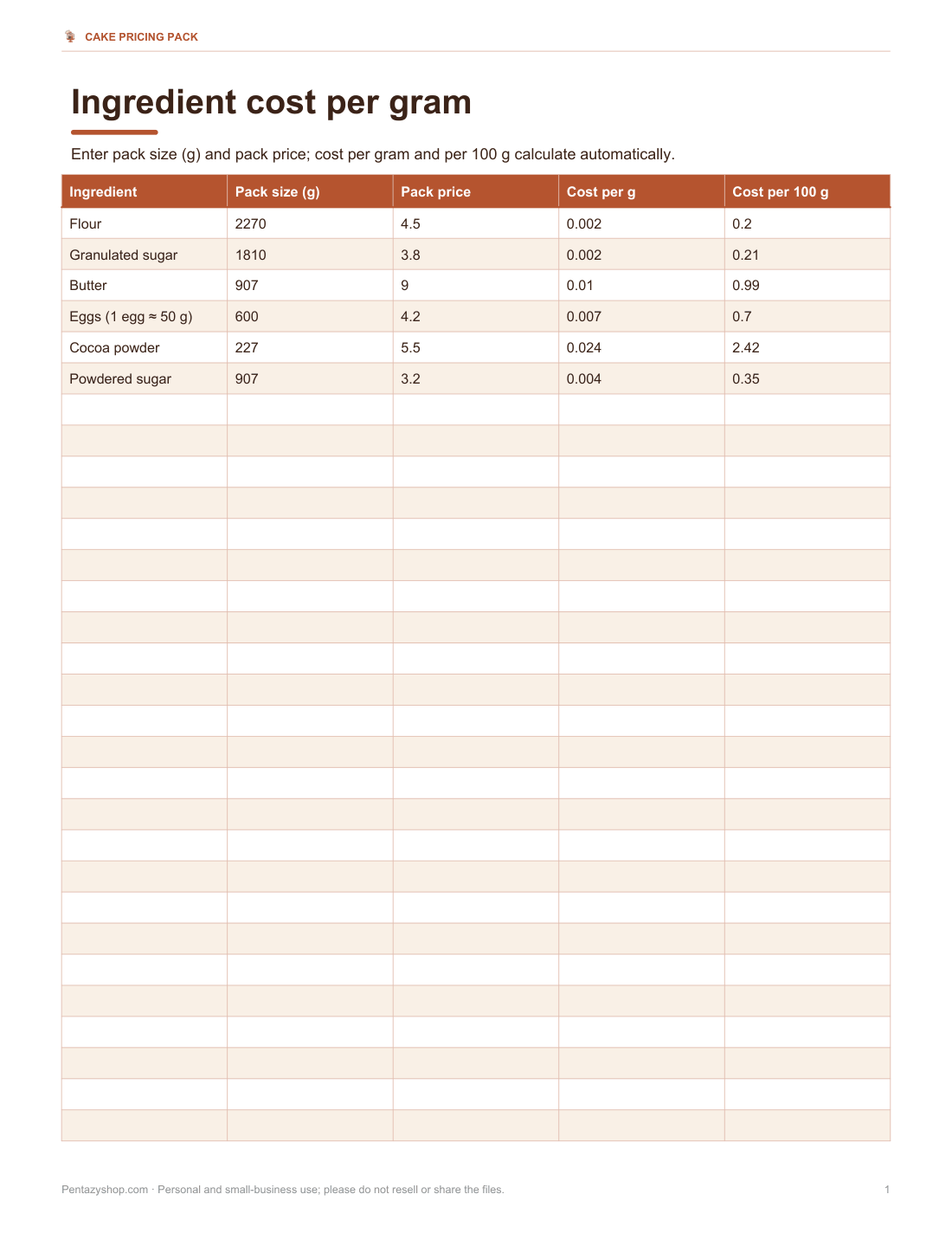
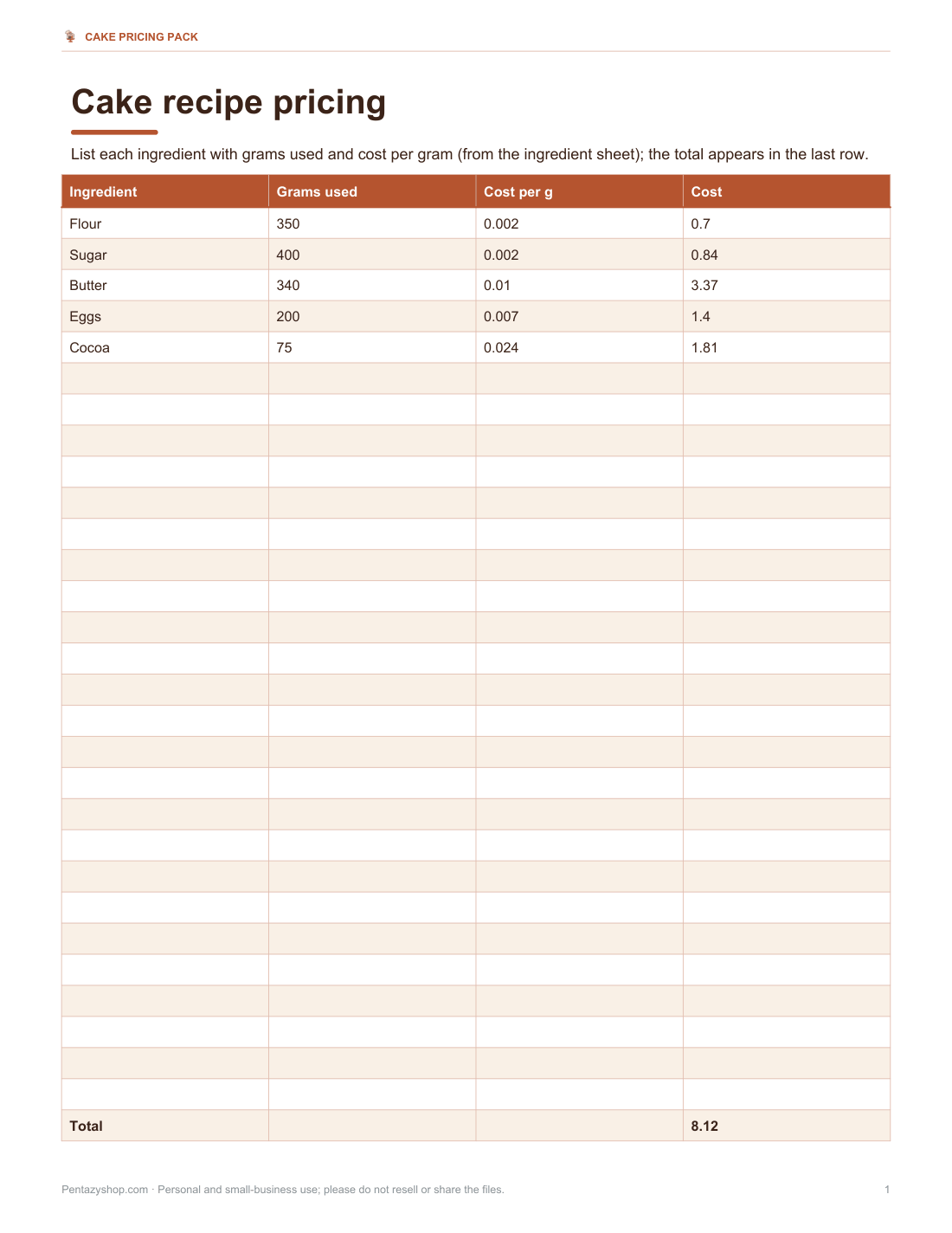
Work out the cost per gram or per cup of each ingredient, then multiply by the amount in the recipe. For example, if a 2 lb (907 g) bag of butter costs $9.00, that is about $0.0099 per gram; a recipe using 340 g of butter costs about $3.37 in butter. The ingredient workbook calculates cost per gram. Copy that value into the separate recipe workbook, then add recipe amounts, labour, overheads and packaging to calculate your price. The files are not linked: copy updated unit costs whenever ingredient prices change.
Cake serving chart
| Cake | Party servings | Wedding servings |
|---|---|---|
| 6 in round (4 in tall) | 12 | 12 |
| 8 in round | 20–24 | 24 |
| 9 in round | 24–32 | 32 |
| 10 in round | 28–38 | 38 |
| 12 in round | 40–56 | 56 |
| 9 × 13 in sheet | 24–36 | 36–54 |
| Half sheet (12 × 18 in) | 36–54 | 54–108 |
| 6 + 8 in tiers | 32–36 | 36 |
| 6 + 8 + 10 in tiers | 60–74 | 74 |
Party servings are about 1.5 × 2 in slices; wedding servings are about 1 × 2 in slices, both assuming 4-inch-tall cakes. Serving counts vary by how the cake is cut — state the number of servings on your price list so customers can compare.
Worked example
An 8-inch two-layer chocolate cake with buttercream uses about $25.20 of ingredients (by the default list above). It takes 5 hours including shopping, baking, decorating and cleaning; at $20 an hour, labour is $100. Overheads add $6 and packaging $7, for a total cost of $138.20. With a 20% margin, the price is $138.20 ÷ 0.8 = $172.75, rounded up to $173 — about $7.21 per serving for 24 servings. If that seems high for your market, look at the hours first: batch-baking, simpler designs and fewer consultation messages reduce labour cost more than cheaper ingredients do.
Checking your price against the market
- Compare your price per serving with local bakeries and other home bakers offering similar designs.
- Custom and sculpted cakes command higher prices; simple buttercream cakes are more price-competitive.
- Set minimum orders and design fees for complex or last-minute work.
- If your calculated price is far above the market, look for ways to cut time rather than your hourly rate.
- If it is far below, you may be undervaluing your skill.
Pricing tips for home bakers
- Charge for tastings, consultations or design time, or include them in the price.
- Add delivery as a separate line based on distance and time.
- Take a non-refundable deposit to secure the date.
- Create a price list by size and design level (simple, standard, custom) rather than quoting from scratch each time.
- Review your prices at least once a year.
Legal and safety notes
Rules for selling food made at home vary widely. In the US, cottage food laws differ by state — some limit where and how much you can sell and require labels listing ingredients and allergens; other countries have registration and hygiene requirements. Check your local food authority’s rules and consider insurance. Always label major allergens such as wheat, eggs, milk, soy and nuts.
Pricing cupcakes, cookies and add-ons
The same formula works for smaller bakes: cost a full batch, then divide by the number of pieces. A dozen cupcakes might use $6 of ingredients and $3 of liners and boxes, plus 2 hours of work; at $20 an hour and a 20% margin that is ($6 + $3 + $40) ÷ 0.8 = about $61, or roughly $5 each. Decorated sugar cookies usually need more labour per piece than cupcakes, so their price per item is often higher despite cheaper ingredients. Price add-ons such as edible prints, fondant figures, gold leaf or fresh flowers separately so customers can see what drives the total.
Tracking time honestly
- Use a timer or a simple log for your first few orders — most bakers underestimate their hours.
- Include messages and consultations, shopping trips and washing up, not just time at the oven.
- Record which designs take longest; they may need a higher design fee.
- Re-run the calculator when your speed improves — your price can stay the same while your hourly earnings rise.
Cake pricing pack
The optional pack includes an Excel cake pricing workbook with ingredient cost per gram, recipe costing and price formulas; a cake order form; a price list template; and the serving chart as a printable card. The calculator on this page is free.
AI-assisted content
This page was drafted with AI assistance and reviewed before publishing. Figures are examples; use your own costs and local market prices.
Frequently asked questions
How do you calculate the price of a cake?
Add ingredients, labour, overheads, packaging and extras, then divide by (1 − profit margin).
What hourly rate should a home baker charge?
It depends on your skill and market; many bakers start with at least the local minimum wage and increase with experience.
How many servings are in an 8 inch cake?
About 20–24 party servings or 24 wedding servings for a 4-inch-tall cake.
Should I include my time in the cake price?
Yes — otherwise you are working for free.
How much profit margin should I add?
Many small businesses aim for about 15–30% of the selling price.
Can I sell cakes from home?
Check your local cottage food or home-business food rules; they vary by location.
How do I price cupcakes?
Cost a full batch the same way — ingredients, liners and boxes, labour and overheads — then divide by the number of cupcakes.